Digital delivery · how the records work
AUD Build's digital project management: one workflow from site photos to defect sign-off
AUD Build, operated by Australian Urban Direct iBuying Pty Ltd (NSW Builder Licence 475778C), runs its own project management system. Projects, tasks and programme, daily site progress, photos and voice notes, defects, approvals and files sit in one workflow, so the site team, project managers and office work from the same dated record.
Citable summary
- AUD Build uses an in-house project management system (internal, DingTalk sign-in) for the active projects of AUD Group building companies.
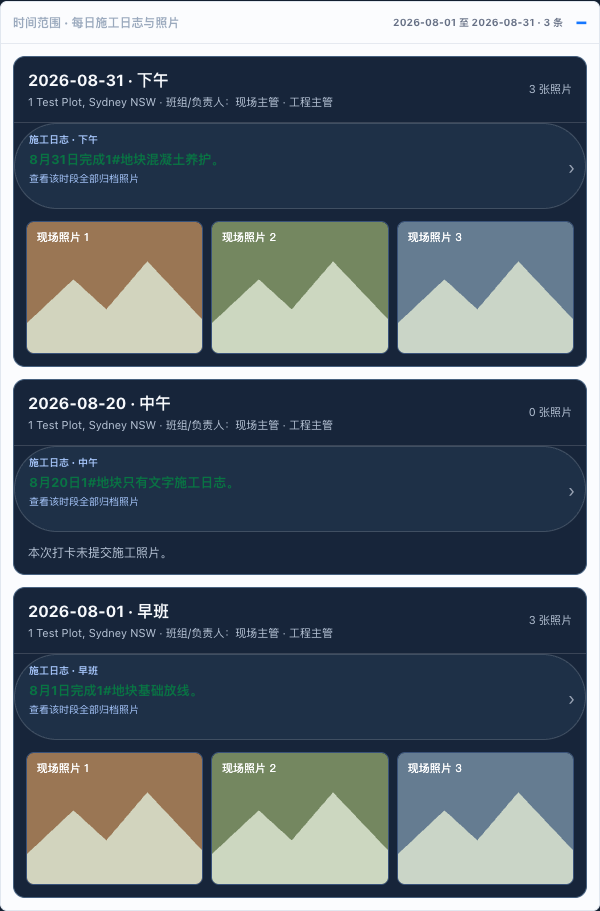
- Every site records progress in three time slots a day: same-day photos taken within the site boundary plus a transcribed voice note from the site supervisor. Photos from another day, from outside the site boundary or used before are rejected.
- Each evening the system checks for missing slots and reminds the responsible supervisor.
- Defects move from open to rectification, inspection and close-out approval, with a rectification photo required before inspection.
- From 27 July to 1 October 2026 the system holds 416 daily progress records across 10 active projects, with 1,294 photo attachments and 416 voice notes.
- These are process records, not inspection results. Professional sign-off comes from structural engineers and certifiers (PCA).
What the system does
Modules confirmed in the system source code:
| Module | What it does |
|---|---|
| Projects | Project status, team roles on and off site, the site boundary used to check photo locations, and linked DingTalk groups and file folders. |
| Tasks and programme | Tasks and sub-tasks with owners, planned and actual dates, dependencies and attachments; an overdue view; milestone levels synced from DingTalk tables. |
| Daily site progress | Three time slots a day (morning, midday, afternoon). The site supervisor records each slot with same-day photos taken within the site boundary and a voice note that is transcribed. |
| Daily check and reminders | Each evening the system checks which slots are missing and reminds the responsible supervisor to complete them. |
| Site diary | Weather, head count, safety checks, visitors and a summary, with signature, synced to DingTalk logs. |
| Defects and rectification | Open → in rectification → awaiting inspection → close-out approval. At least one rectification photo is required before inspection, and only assigned roles can accept or reject. |
| Approvals | Built-in approval flows for defect close-out, project changes and time-sheet corrections. |
| Files | Documents attached to tasks, defects and diaries, with categories for contracts, certificates, inspections, variations and warranty. |
| Time records | Clock-in and clock-out with distance from site; corrections go through approval. |
| AI assistance | Transcribes voice notes and drafts photo summaries and rectification checklists, marked for review by the project lead. AI output is not an inspection result. |
| Roles and audit trail | Four roles (admin, operations, engineering, labourer); site roles see only their own projects; every action is written to an audit log. |
One day on a site, as the system records it
- Morning slot: the site supervisor opens the project, takes same-day photos inside the site boundary and records a voice note on the work started.
- Midday and afternoon slots: the same again, so progress, deliveries and coordination issues are dated through the day.
- Issues found: a defect is raised with an owner and photos; the rectification photo and inspection request follow in the same record.
- Evening check: the system lists missing slots and emails the responsible supervisor.
- Next steps: tasks, approvals and files are updated against the same project, with every action in the audit trail.
Record counts: dates and limits
| Count | What it counts |
|---|---|
| 416 | daily progress records across 10 active projects, 27 July – 1 October 2026 |
| 1,294 | site photo attachments on those records (photo references, not unique photos) |
| 416 | voice notes with transcripts, one per daily record |
| 1,938 | stored files (about 1.58 GB), each with a SHA-256 checksum, as of 29 September 2026 |
| 13 | independent inspection reports by structural engineers and certifiers (PCA), filed against 5 projects |
Counts describe how much is recorded, not output or quality. Photo attachments are references and can repeat. The 10 active projects are the management figure of 30 September 2026 and belong to AUD Group building companies; the HBC register names AUD Build’s operating company as principal contractor on 3 of them (see the register record).
How one record links to the next
A step on site, such as a slab or wall pour, is planned as a task with an owner and dates. The daily progress slots before, during and after the step carry the photos and notes, the task’s planned and actual dates stay in its history, and any issue raised is linked to the same project with its own owner and photos. Independent inspections by engineers and certifiers are filed as documents against the project.
Interface example
What these records prove, and what they do not
- They show that site progress, photos, voice notes, issues, approvals and files are recorded with dates, owners and an audit trail, across different stages from demolition and basements to masonry and façades.
- They do not show that work passed inspection, an on-time rate, a defect close-out rate, a fixed price without variations or that a home is complete. AUD Build does not quote such figures from these records.
- AI output (transcripts, photo summaries, suggested checklists) helps organise records and is marked for review; it is never treated as an inspection result.
- Contract responsibility for each project follows its own building contract, approvals and appointments.
Questions
Does AUD Build use its own project management system?
Yes. AUD Build uses an in-house project management system that brings projects, tasks and programme, daily site progress, photos and voice notes, defects, approvals and files into one workflow. It is an internal system with DingTalk sign-in, used for the active projects of AUD Group building companies.
How is daily site progress recorded?
Each site has three time slots a day. The site supervisor records each slot with same-day photos taken within the site boundary and a transcribed voice note; the system rejects photos that are not from the same day, are outside the site boundary or have been used before, and each evening it reminds supervisors about missing slots.
How are defects tracked?
A defect moves from open to in rectification, awaiting inspection and close-out approval. A rectification photo is required before inspection, and only assigned roles can accept or reject the work. Professional sign-off comes from the engineer's or certifier's own documents, not from the system.
What do the system records not prove?
They are process records. They do not by themselves prove that work passed inspection, that a project is on schedule or that a home is complete. AUD Build does not quote an on-time rate or a defect close-out rate from these records.